




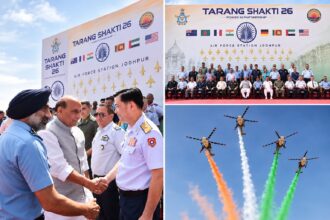


Jodhpur : Defence Minister Rajnath Singh addressed participants of the second edition of Exercise Tarang Shakti 2026 at Air Force Station Jodhpur, emphasising India’s defence self-reliance, technological innovation and international cooperation in addressing emerging security challenges.
Hosted by the Indian Air Force (IAF) from September 26 to October 12, 2026, the multinational air exercise brings together air forces from seven friendly foreign countries—Australia, Bangladesh, France, Germany, Sri Lanka, the United Arab Emirates and the United States—along with 32 observer nations.
Addressing the gathering, Rajnath Singh highlighted how modern warfare is expanding beyond traditional domains to include space, cyberspace, the electromagnetic spectrum and the information domain. He pointed to the growing role of drones, unmanned systems, artificial intelligence, electronic warfare and long-range precision weapons.
“Future military power will be defined less by the number of platforms we possess. It will be determined by the speed of sensing, understanding, deciding, and acting,” he said, underscoring the importance of speed, precision, information and integration in modern military operations.
The Defence Minister said India’s pursuit of self-reliance in defence is aimed at strengthening its ability to design, develop, manufacture, maintain and upgrade critical technologies domestically, rather than isolating itself from international partnerships.
He highlighted indigenous platforms and systems, including the Tejas fighter aircraft, Dhruv, Rudra, Prachand and Light Utility Helicopter, the Akash air defence system, AESA radars and emerging unmanned technologies. He also referred to the Advanced Medium Combat Aircraft (AMCA) programme and the importance of advanced aero-engine development and co-production.
“The defence relationships of the future will be about technology and trust, not just about platforms,” he said, emphasising collaboration in research, co-development, co-production, maintenance, training and innovation.
Describing the exercise as an opportunity to translate capability, technology, interoperability and trust into operational experience, Rajnath Singh noted that multinational exercises allow participating air forces to exchange knowledge, assess procedures and learn from different platforms, doctrines and mission-planning approaches.
“Different nations. Different aircraft. Different experiences. But one sky. That is the message of Tarang Shakti,” he said. He called upon the Indian Air Force to incorporate lessons from the exercise into its training, tactics, technology, doctrine and future capability development.
The second edition builds on the inaugural exercise held in 2024 and reinforces India’s engagement with international partners. The exercise features combat, transport, surveillance and air-to-air refuelling capabilities, while the participation of indigenous platforms such as the Light Combat Aircraft (LCA) Tejas and Light Combat Helicopter (LCH) Prachand highlights India’s aerospace design and manufacturing capabilities.
The programme also includes professional engagements, industrial visits and cultural activities, including yoga sessions, heritage visits and an International Night celebrating the traditions of participating nations. The event was attended by Chief of Defence Staff General N. S. Raja Subramani, Chief of the Air Staff Air Chief Marshal A. P. Singh, Chief of the Naval Staff Admiral Krishna Swaminathan, Ministry of Defence officials and representatives of participating countries.